Showing posts with label Charlotte Mason. Show all posts

Thursday, May 3, 2012

Mountains of Playdough

Earth science is exciting! Studying about mountain formation is fascinating. But how to keep everyone engaged- that's the question. So instead of just reading about how mountains are formed, we formed them ourselves out of playdough.

To begin with, I needed a lot of playdough. I multiplied the recipe by six, then divided the playdough into four balls and colored three of them different colors. We rolled out the balls into layers and cut them into four parts, because I have four kids doing this activity.

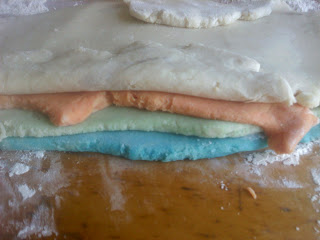

Next I assigned each kid a different type of mountain. One made the folded mountains, like our Blue Ridge Mountains. These were made by exerting  inward pressure on both sides of the slab. 


Another made block thrust mountains by cutting the play dough into three pieces and the outer two push on the inner block causing it to rise as a unit.


This is the dome mountain made by magma building up underneath the earth and pushing it upward.


The volcano mountain doesn't look that great. The orange is the magma that came out of the vent and solidified on top.


This is a mountain caused by the subduction of one plate under another.


This activity is not rocket science, and it's not art, but it did engage all the age groups and help them remember how mountains are formed.

Resources:
cream of tarter playdough recipe

Monday, April 30, 2012

Earth and the Lithosphere


Another week of science. Yeah!
This week we are on Module 6, Earth and the Lithosphere. I am using as my core text Exploring Creation with Physical Science by Jay Wile. This year I have kids in every level. Is it possible for us to do science together? That is the challenge I have taken on.

Schedule:
Monday:   Lithosphere and plate tectonics
Tuesday:Mountain Formation
Wednesday: Volcanoes
Thursday: Earthquakes
Friday: Catch-up day

This chart shows my effort to teach all my levels at once. Activities referenced in the chart are listed in the resource section below.


Kindergarten Elementary Middle School High School
Lithosphere,
Structure of 
the earth
earth layers 
coloring sheet,
magnetic fields
activity. Magic 
School Bus "Inside
the Earth"
SC Landforms
earth layers coloring
sheet, geomag 
comic book,

magnetic fields
activity,


Magic 
School Bus "Inside
the Earth"


SC Landforms
earth layers
coloring sheet,

geomagnatism
comic book,

magnetic fields
activity, Magic 
School Bus "Inside
the Earth"

Lithosphere 
facts, SC Landforms,

geomagnatism
comic book,

magnetic fields
activity

Plate 
Tectonics
plate tectonics
coloring pages
plate tectonics
worksheets

plate tectonics
worksheets

plate tectonics
worksheets
Earthquakes Bill Nye
Earthquakes
Deadliest
Earthquakes
Nova

Bill Nye
Earthquakes
Deadliest
Earthquakes
Nova,

Bill Nye
Earthquakes
Deadliest
Earthquakes
Nova,

Bill Nye
Earthquakes
Volcanoes Magic School Bus
Blows Its Top
Deadliest
Volcanoes,

Magic School Bus
Blows Its Top
Deadliest
Volcanoes,

Magic School Bus
Blows Its Top
Deadliest
Volcanoes
Mountain
Formation
Mountain
formation
activity

Mountain
formation
activity

Mountain
formation
activity

Mountain
formation
activity

Monday, April 23, 2012

Module 5 and 4: The hydrosphere and the wonder of water


I'm rearranging the order of the book (again) to make the flow of ideas a little better. We have already covered clouds and cloud formation, so we will skip that part and talk about the water cycle and what is so unusual about water. At the end of the week we will talk about groundwater, because that will bridge nicely into the lithosphere.

Schedule:
Monday: Hydrosphere and water cycle. Watch Magic School Bus and do worksheets on water cycle. Module 5
Tuesday: Properties of water experiments and worksheets. Module 4
Wednesday: Properties of water experiments and worksheets. Bending water experiment.
Thursday: Glacier video
Friday: Understanding groundwater video. Build an aquifer in a cup.
Notes:
The aquifer in a cup is a great activity.

The groundwater video is a little hard to understand.

We did this experiment from the properties of water link in the resource section below, comparing the heat properties of different liquids.
We heated 40 ml of alcohol, 40 ml of oil and 40 ml of water and graphed the temperature while they were being heated to the boiling point and then cooled. We did this using a vernier stainless steel thermometer and a go link plugged into the computer and graphed with logger lite software. The kids loved it. They could actually see the difference between the two liquids in their ability to heat up hold heat.Unfortunately, when I heated the oil, I lost my heat sensor.

This is what alcohol looked like.


This is what water looked like.

This is oil. You can tell right where I burned out my temperature sensor.

Resources:

The Magic School Bus Ups and Downs


I really like this link because it ties the properties of water to the hydrosphere.


Wonderful explanation of the properties of water part 1


Understanding Groundwater parts 1 and 2


Bill Nye and the Water Cycle


Magic School Bus and Wet all Over


The hydrosphere for younger children


Monday, April 9, 2012

Weather Module 7

This week I'd like to do fewer videos and more reading and hands on. We've already talked about clouds somewhat, so the first order of business is to set up our own weather station. We will make our own instruments.  I think the kids will learn more by reading the instruments themselves rather than getting all the information off the web. Here is our schedule.

Monday: Pages 157-161 on clouds. Make barometer and rain gauge.
Tuesday: pp 161-165 Earth's thermal energy.
Wednesday: 165-171 Latitude/Longitude, wind patterns Make weather vane
Thursday:171-176 Air Masses
Friday: Study questions


Resources

Blank weather chart

vocabulary

make your own weather instruments

US wind map

Estimate the wind speed without an anemomeeter

A blank weather chart I created. Enough space for 2 weeks

Latitude and Longitude game


Global Wind Pattern visualization
Six Major Wind Belts

Latitude and Longitude


Air Masses

Monday, March 26, 2012

Module 3: Atmosphere

To be honest, I am still struggling with the way Wile has organized the whole air/atmosphere/weather units. I am going to rearrange things a little bit here, and instead of covering atmospheric pressure first, I am going to cover the layers of the atmosphere and from there go to weather which will include atmospheric pressure.

I was gone all weekend, so will finish the lesson plans for the rest of the week tonight. This should get us through the day.

Monday: pg. 62-76 layers of the atmosphere. Watch videos of the layers of the atmosphere. Draw in notebook the layers and what occurs in each layer. Note that no other resource I've come across calls this the homosphere.
Tuesday: Aurora video from NASA.
Wednesday: plot where to see auroras on map. See Dancing in the Night Sky activity
Thursday: make a magnetometer to measure solar storms. See magnetometer activity.
Friday: Notebooking activity. Take picture of sky and note the kind of clouds. Do this every day for two weeks. Watch Bill Nye the Science Guy video on the atmosphere. We got ours from the library.

AFTER REMARKS

Bill Nye Atmosphere was not as good as his other videos. I wouldn't watch it again.

Dancing in the Night sky worked out well, along with the mapping  aurora activity from NASA.

Structure of the atmosphere was worth watching.

RESOURCES


NASA solar storm math activity


make a magnetometer-measure solar storms- NASA


Links to atmosphere and weather lessons, worksheets and videos

video and interactive links to the atmosphere. Nova segments

NASA links on the atmosphere

Video on the structure of the atmosphere.


Great Video on Auroras from NASA


Activity to go with NASA video "Dancing in the Night Sky"

Saturday, March 17, 2012

Module 2: Air

This module covers humidity, air composition, greenhouse gasses, ozone and air pollution. I would like to spend more time humidity, and broaden it to include dew point, and spend less time on greenhouse gases ozone and air pollution.

Schedule
Monday: Watch videos on humidity and dew point, and do the activity to find the dew point and the activity to make a cloud in a bottle. Record activities in notebook.
Tuesday: Do the activities to model and find the relative humidity in the classroom. Put worksheets in notebook.
Wednesday: Read the section on the composition of air and check out the discovery of nitrogen site.Draw a diagram showing the composition of air in notebook.
Thursday: Read about the greenhouse effect and global warming. Do lab on greenhouse effect. Fill out lab report and put in notebook. Find lab sheets here
Friday: Read and talk about ozone. Using a rope, demonstrate the difference between a high energy wave and a short energy wave. See resource activities on ozone. Go to the air pollution site and watch how they have been tracking the amount of pollutants in the air for the past 10 years.

You will notice I don't spend much time testing. We talk and discuss the subject so much I know what they understand.

Resources

Air- Humidity and Dew point
Video: relative humidity and dew point. Good explanations of the difference.


Very good video on humidity and dew point. Has a couple simple experiments on finding the dew point and making a cloud in a bottle.


Worksheet on how to find the relative humidity in your classroom/home, and making models to show visibly the difference between cold and warm air and the amount of moisture they hold.

Air Composition 

Great site on the discovery of the different components of air. 

Ozone 

Good explanation of ozone with related activities

Air Pollution

Video on how pollutants have been tracked for 10 years, showing that the clean air act of 1999 really has improved our air quality.


Friday, March 9, 2012

Module One: Atoms and Molecules, Units of Measurement

Module One is an introduction to matter and measurement. This will be review for the older students.The preschooler will sit in with us as we watch the movies and do the experiments. Everyone will have their own notebook to record what we did for the day, whether it's a video, worksheet or experiment. Even the preschooler will draw pictures and write simple sentences of what we are doing. To be honest, the preschooler is actually more on a kindergarten level. Below is my schedule for next week, with the resources listed below the schedule. We'll see how it goes.

Schedule
Monday: Introduce atoms with Bill Nye the Science Guy video. Build a model of an atom using a atom modeling kit. Write about what you did and put in notebook.
Tuesday: Electrolysis experiment. Use lab report template and put report in notebook.
Wednesday: ECPS pp. 7-17,  Experiment 1.2 Cubits and Fingers. Use lab report and put in notebook.
Thursday: Metric Conversion Worksheet
Friday: Concentration experiment. If I dilute the vinegar, will it still react to baking powder? Observe the reaction of baking powder to different concentrations of vinegar. Use water as a control.
Steps to a good experiment


Resources

Videos


Bill Nye the Science Guy- Atoms 1/2


Bill Nye the Science Guy- Atoms 2/2

Experiments

This is basically the same experiment as found on page 2 in Exploring Creation with Physical Science but it has better explanations and includes instructions for capturing the hydrogen and oxygen and for more advanced students, the mathematical calculations that go with it.
Electrolysis Experiment

Worksheets and Online Quizzes

Metric Conversion Worksheet

Interactive Quiz on Converting Metric Length

Worksheets and ppts covering middle school science

Online games and videos on atoms

Lapbooking and Notebooking


Great lapbook and notebook ideas for atoms.

Chemistry unit study. Includes scientist biographies

Lab report template

Notebook pages on atoms